
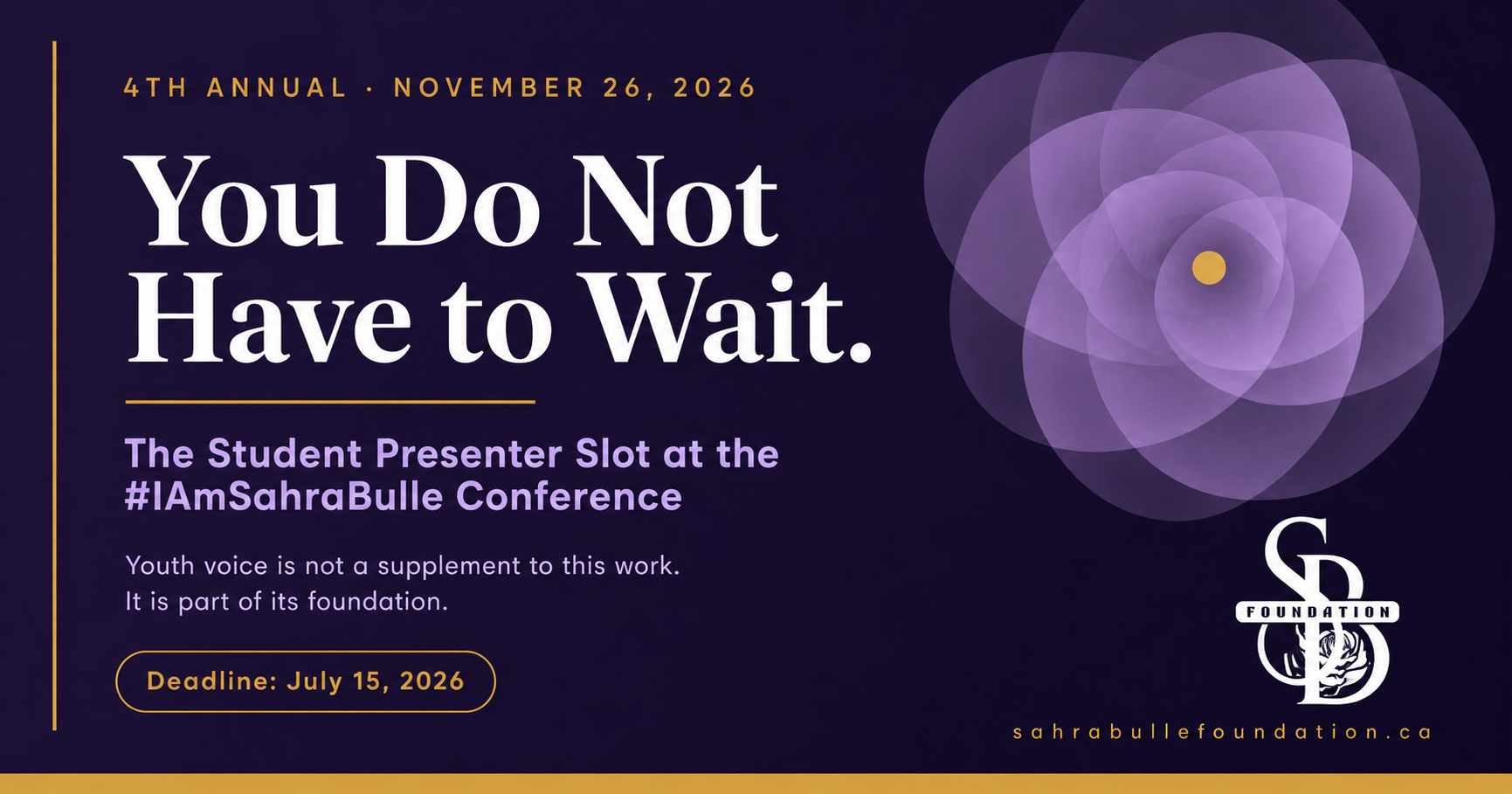
You Do Not Have to Wait: The Student Presenter Slot at the 2026 #IAmSahraBulle Conference
There is a common assumption in conference culture that young people belong in the audience. The Sahra Bulle Foundation does not share that assumption. The 4th Annual #IAmSahraBulle Conference includes a dedicated student presenter slot — not as an add-on, but as a protected space in the program. Because youth voice is not a supplement to this work. It is part of its foundation.
There is a common assumption in conference culture that young people belong in the audience. That they need a few more years — more credentials, more distance from their own experience, more institutional legitimacy — before they have something worth presenting.
The Sahra Bulle Foundation does not share that assumption.
The 4th Annual #IAmSahraBulle Conference, taking place November 26, 2026, at Vanier Hall, University of Windsor, includes a dedicated student presenter slot in its program. It is not an additional, optional add-on. It is a protected space — guaranteed in the program, valued equally alongside every other session — because youth voice is not a supplement to this work. It is part of its foundation.
What the Student Presenter Slot Is
The student presenter slot is a 15-to-30-minute session designed for, and led by, young people. The format can be a spoken word piece, a presentation, a performance, or a facilitated discussion. What it cannot be is a passive lecture — like every session in this conference, it is designed to engage the people in the room.
This slot exists because the #IAmSahraBulle Conference centres action. "From Awareness to Action: Ending Violence in Our Homes, Schools, and Communities" is the 2026 theme — and that action is not generational. It does not begin at 25 or 30 or after you have finished your degree. It begins when someone understands why silence is not protection and decides to say so out loud.
Who Should Apply
The student presenter slot is open to:
High school and post-secondary students currently enrolled in a Windsor-Essex or Ontario institution
Student groups and advocacy organizations working on gender-based violence, community safety, equity, or related issues
Youth advocates under 25 who are working with a community organization, whether or not they are currently enrolled in school
You do not need to be a polished speaker. You do not need prior conference experience. You do not need academic credentials or a formal institutional affiliation. You need something genuine to say — and the commitment to say it in a way that respects the people in the room who may carry their own experiences of gender-based violence.
The Foundation's program team provides a preparation call for every presenter, including students. No one who is accepted to this program prepares alone.
The Simplified Submission Process
The student submission process is designed to remove the barriers that stop young people from applying. Here is what we ask for:
Your name, school or organization, and grade or year of study
What you want to present — in plain language, two to three sentences
Why this topic matters to you and to the people who will be in the room
What format you are thinking of: spoken word, presentation, performance, or facilitated discussion
That is the full application.
Email your proposal to info@sahrabullefoundation.ca with the subject line: Student CFP 2026 — [Your Name]. The deadline is July 15, 2026. Presenter notification goes out August 15, 2026.
A Note to Educators and Community Workers
If you work with students — in schools, youth organizations, community programs, or advocacy groups — we ask you to share this call directly with the young people you work with. You know who has something to say. You know who has been waiting for a space to say it.
The student presenter slot exists because the next generation of advocates in this work deserves a platform, not just a seat. Send this to the students in your circle.
Learn more and submit at sahrabullefoundation.ca or reach us directly at info@sahrabullefoundation.ca.
This call is open to all students and youth advocates working to end gender-based violence in their communities.
Conference date: November 26, 2026 — Vanier Hall, University of Windsor.
Free for all attendees. Education. Accountability. Community. #IAmSahraBulle
Education. Accountability. Community.
#IAmSahraBulle
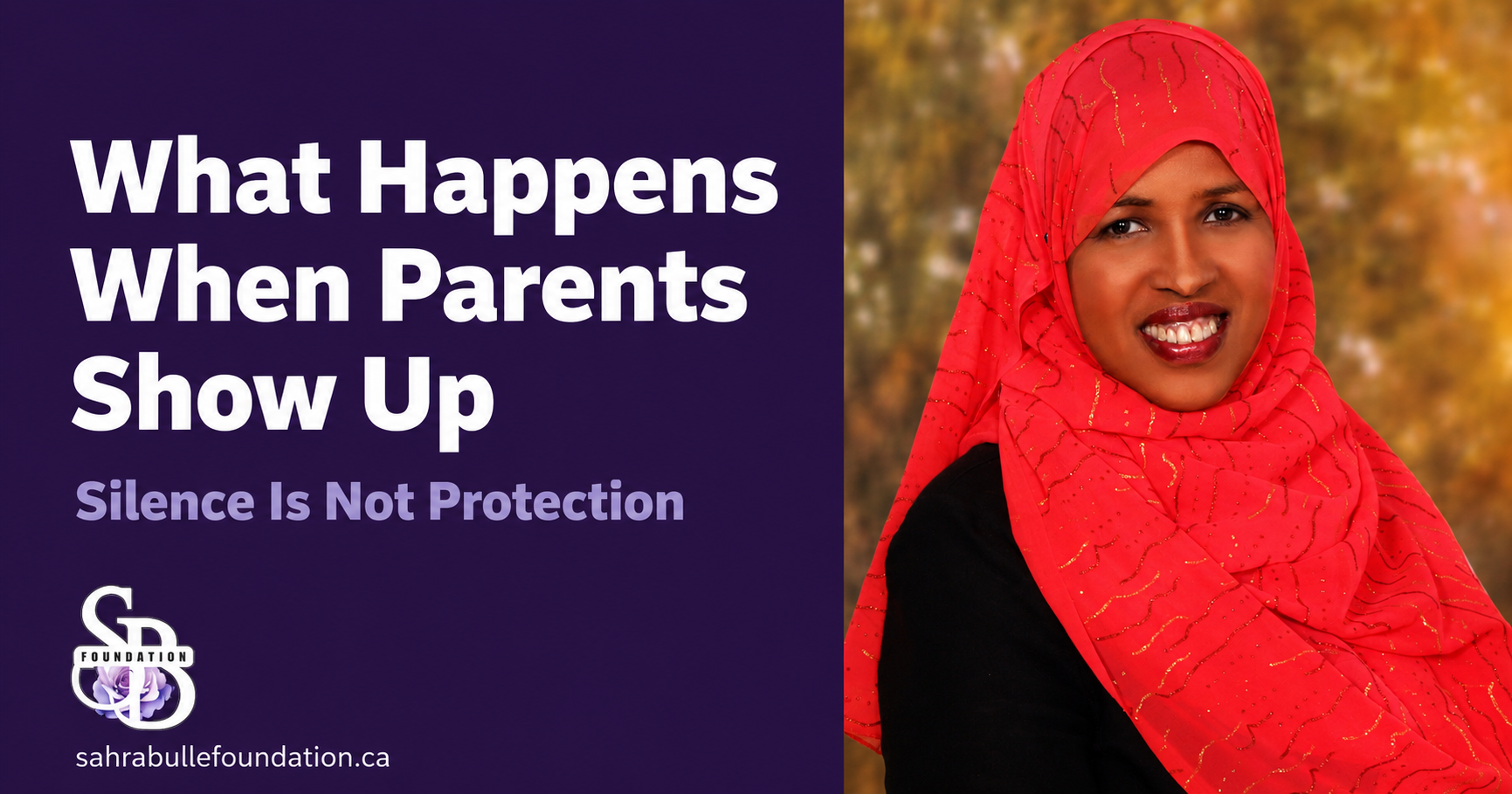
What Happens When Parents Show Up
Last Wednesday evening, parents gathered for the Sahra Bulle Foundation Centre for Learning and Teaching's first virtual workshop — Silence Is Not Protection. They came in prom season. They came carrying questions about co-parenting, about college-bound children, about teenagers who had already started dating. They came because something in them knew that silence was not enough — even if they did not yet have the words to replace it.
Last Wednesday evening, parents gathered for the Sahra Bulle Foundation Centre for Learning and Teaching's first virtual workshop — Silence Is Not Protection.
They came in prom season. They came carrying questions about co-parenting, about college-bound children, about teenagers who had already started dating. They came because something in them knew that silence was not enough — even if they did not yet have the words to replace it.
I have been thinking about them ever since.
The Sentence That Closes the Door
The session opened with a truth that most parents in the room recognized immediately: we go silent not because we do not care, but because we do not know what to say. We are afraid of pushing our children away. We tell ourselves it is not serious yet. We are afraid of saying the wrong thing.
And sometimes, when we do speak, we say exactly the wrong thing — not because we are bad parents, but because we are afraid ones.
I shared my own story. My daughter Zahra met her partner when she was 18 and he was 27. My first response was to attack the relationship. And every word I said was used by her partner as a weapon — evidence that the world was against them, that coming home meant proving him right.
When we attack the relationship, we make the relationship something to defend. A controlling partner monitors everything. Whatever you say will be heard. The question is not whether to speak. The question is how to speak so that your words cannot be turned against your child.
Words That Open Doors
The session introduced a framework parents can use immediately — language that centres the child's safety and worth rather than the partner's flaws.
Instead of "I don't like this person" — which makes the relationship something to defend — try: "Are you safe in this relationship?"
Instead of "You need to leave" — which makes the parent the decision-maker — try: "You can always come home. Not when things are perfect. Anytime."
Instead of "I told you this would happen" — which introduces shame at the moment your child most needs not to be shamed — try: "I noticed something, and I have been carrying it. Can I share it with you?"
The most dangerous sentence a parent can say is this one: "If you go back, don't come to me." It removes the safety net. It forces the child to choose between their pride and their safety. Zahra left her relationship 11 times over 18 years. Each time, the door was open. Each return was not failure — it was the open door working.
The Five Doorway Moments
Parents do not need to manufacture conversations. They need to recognize the moments that are already there.
The Five Doorway Moments Framework — included in the free Parent Toolkit — identifies five threshold situations when young people aged 14 to 20 are most open to conversation: prom season, leaving for university or college, starting to date, asking about dating, and approaching a family dating age rule.
Each one is an invitation. The question is whether a parent is ready to walk through it.
One World Health Organization statistic shared during the session stayed with the room: one in four teens aged 15 to 17 have experienced dating violence. Most do not feel comfortable talking about it with anyone. That silence is not protection. It is isolation.
The Pledge
Every parent who attended Wednesday's session closed with the Open Door Pledge — a commitment not to perfection, but to presence. To speak even without the perfect words. To listen more than they instruct. To never make their child choose between their pride and their safety. To mean it when they say: you can always come home.
The conversation does not have to be perfect. It just has to happen.
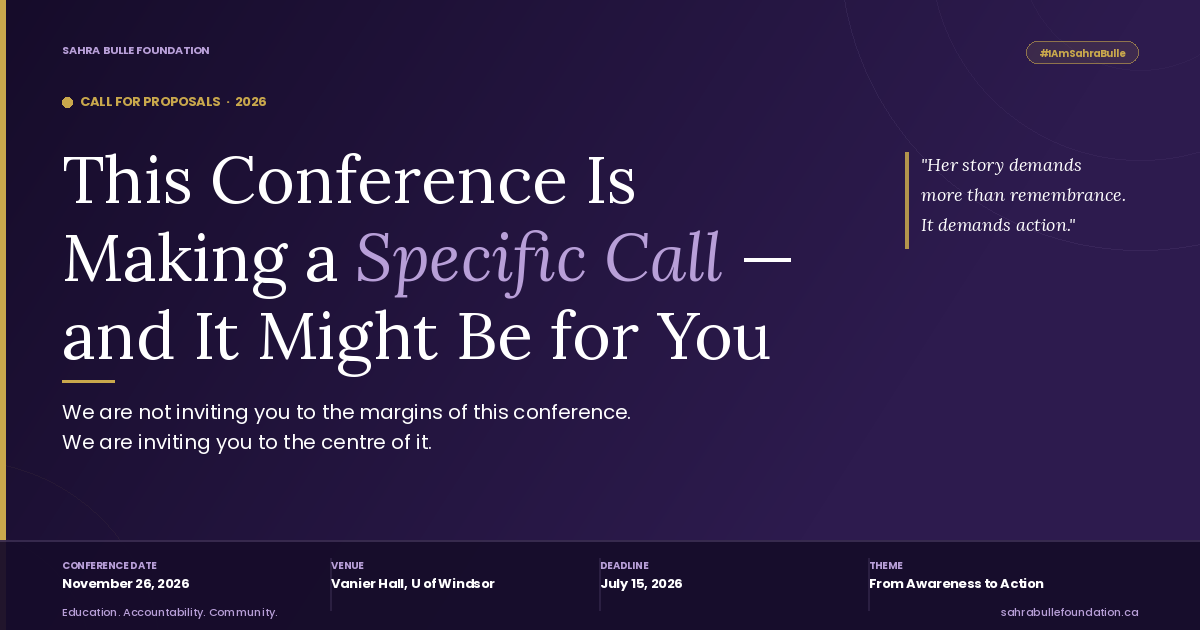
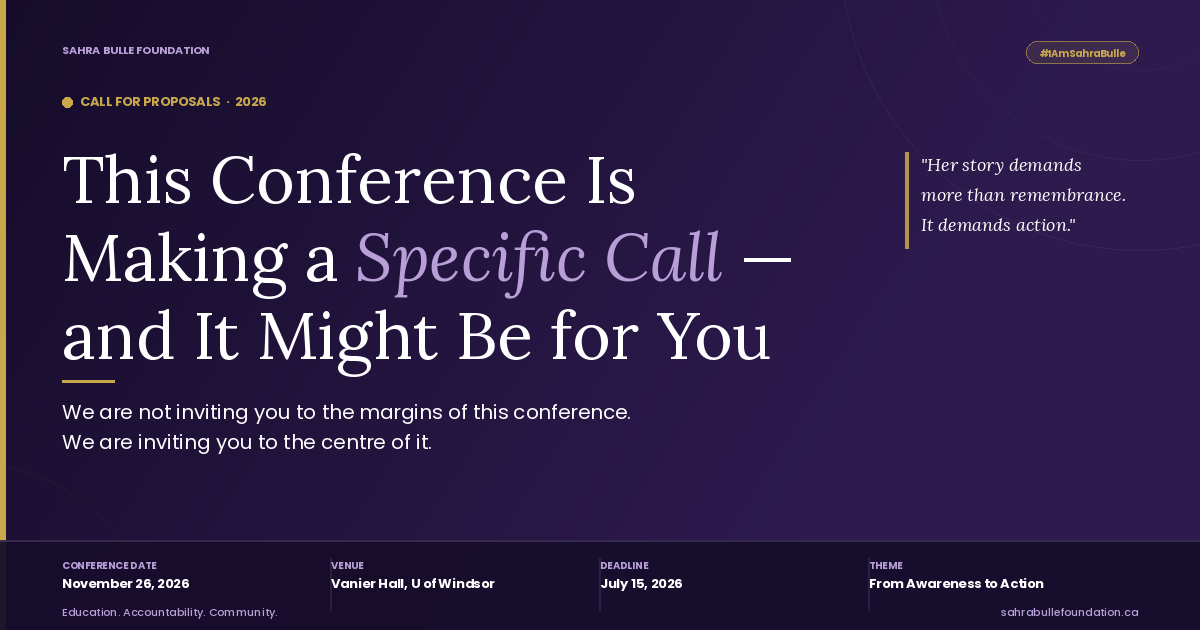
This Conference Is Making a Specific Call — and It Might Be for You
The call for proposals is open. The 4th Annual #IAmSahraBulle Conference — themed 'From Awareness to Action: Ending Violence in Our Homes, Schools, and Communities' — is looking for sessions that move people from knowledge to practice, and from reflection to sustained community commitment. The deadline is July 15, 2026.
The #IAmSahraBulle Conference is open to everyone. But this week, we want to speak directly to a particular group of people: Black women, Indigenous women, immigrant and refugee women, women with disabilities, and LGBTQ2S+ women who have something to contribute to the conversation about gender-based violence.
We are not inviting you to the margins of this conference. We are inviting you to the centre of it.
The 2026 theme is "From Awareness to Action: Ending Violence in Our Homes, Schools, and Communities." That theme cannot be addressed honestly without the voices of those who experience gender-based violence at disproportionately higher rates and who face compounded barriers when they try to seek safety, support, and justice. Race, immigration status, disability, sexual orientation, language, and economic vulnerability all shape how violence happens and how institutions respond to it. We want sessions that name these intersections directly and offer communities something to act on.
The Sahra Bulle Foundation's 2026 call for proposals includes a specific and structural priority: proposals that centre the experiences of marginalized and racialized women are very important. This is written into the CFP. It is a commitment rooted in who this conference exists for.
What this means in practice: if you are a Black woman working in GBV prevention in Windsor or beyond, we want your proposal. If you are an Indigenous woman offering a healing approach rooted in cultural knowledge or land-based practice, we want your proposal. If you are an immigrant or refugee woman who has built community support structures that the formal system could not provide, we want to hear about it. If you have lived experience with disability and gender-based violence, what institutions get wrong, what actually helps, that is exactly what this room needs.
Artists, spoken word performers, community organizers, frontline workers, researchers with community-facing work, knowledge keepers, and advocates with lived experience: the call is open. We welcome proposals in workshop, interactive presentation, sharing circle, arts-based session, and panel discussion formats. You can also pitch something that does not fit neatly if it responds to the theme with purpose and care, we want to see it.
You do not need academic credentials. You do not need prior conference experience. You need real knowledge, a genuine commitment to trauma-informed facilitation, and something you believe will move people from knowing to doing.
The Foundation's program team is available to help you develop your proposal before you submit. Reach out to info@sahrabullefoundation.ca and we will respond within three business days.
The submission deadline is July 15, 2026. The conference takes place November 26, 2026 at Vanier Hall, University of Windsor, held during the UN's 16 Days of Activism Against Gender-Based Violence.
Submit your proposal at https://www.sahrabullefoundation.ca/conference
Her story demands more than remembrance. It demands that we build something real — together.
Education. Accountability. Community.
#IAmSahraBulle
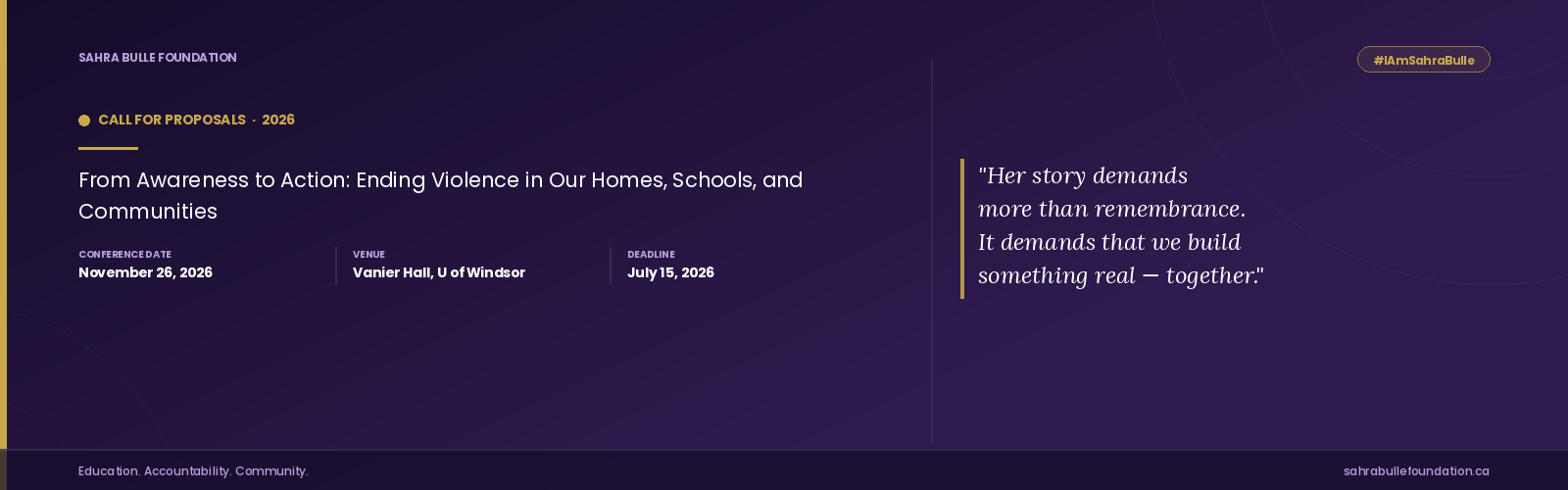
The Call Is Open. Bring What You Know.
The call for proposals is open. The 4th Annual #IAmSahraBulle Conference — themed 'From Awareness to Action: Ending Violence in Our Homes, Schools, and Communities' — is looking for sessions that move people from knowledge to practice, and from reflection to sustained community commitment. The deadline is July 15, 2026.
The 4th Annual #IAmSahraBulle Conference has a harder ask this year.
Not harder in the sense of painful though some of this work is. Harder in the sense that understanding is no longer enough. Three years of learning, dialogue, and community-building have produced a room of people who know what gender-based violence looks like, who it targets, and what it costs. The 2026 conference theme — "From Awareness to Action: Ending Violence in Our Homes, Schools, and Communities" — builds on that foundation and asks: now what?
This is the question the Sahra Bulle Foundation Centre for Learning and Teaching is putting to practitioners, educators, researchers, community workers, artists, and advocates across Windsor-Essex and beyond. The call for proposals is open, and we want your answer.
About the Conference
The #IAmSahraBulle Conference is the annual flagship event of the Sahra Bulle Foundation Centre for Learning and Teaching, held each November during the UN's 16 Days of Activism Against Gender-Based Violence. Now in its fourth year, the conference is co-hosted with the University of Windsor Office of the Vice-President, People, Equity, and Inclusion. It brings together students, educators, frontline workers, community organizations, and advocates for a full day of learning, dialogue, and collective action. Attendance is free, funded entirely through fundraising and donor contributions.
This Year's Theme
"From Awareness to Action: Ending Violence in Our Homes, Schools, and Communities" is grounded in the UN campaign "UNITE: Invest to Prevent Violence Against Women and Girls," which calls for meaningful investment in prevention — not just response. It also connects to 1 Billion Rising's 2026 focus, centering the intersection of gender-based violence, environmental crisis, and bodily autonomy.
We are looking for sessions that move people:
— from awareness to action
— from knowledge to practice
— from reflection to sustained community commitment
The strongest proposals do not just explain the problem. They show what communities can actually do about it.
What We Are Looking For
The CFP outlines ten topic areas to help guide your thinking: the disproportionate impact of GBV on marginalized and racialized women; what accountability looks like in practice in schools, workplaces, and institutions; how communities respond when systems fail survivors; the role of men and boys as co-responsible community members; the intersection of gender-based violence and environmental crisis; digital safety as a concrete practice for youth, survivors, and organizations; the chronic underfunding of GBV organizations; what a trauma-informed institution actually looks like beyond policy documents; healing practices rooted in Indigenous knowledge and cultural tradition; and creative resistance through art, storytelling, spoken word, movement, and music.
These are directions, not requirements. If your work responds to the theme in a way not listed here, we want to hear it.
Every accepted session includes a concrete participant takeaway: one thing people can know, do, or act on differently when they leave the room. Sessions designed without genuine audience participation will not be selected, regardless of topic quality.
Formats include workshops (60-90 minutes), interactive presentations (45-60 minutes), sharing circles (60 minutes), arts-based sessions (45-60 minutes), panel discussions (60 minutes), and a dedicated student presenter slot. All sessions are organized within three conference streams: youth-focused, practitioner and community, and open to all.
Submit: https://www.sahrabullefoundation.ca/conference
If you have questions before submitting, reach out at info@sahrabullefoundation.ca. The program team responds within two business days.
Key dates:
Submission deadline: July 15, 2026 at 11:59 PM EST
Presenter notification: August 15, 2026
Presenter confirmation deadline: September 1, 2026
Session materials due: November 1, 2026
Conference date: November 26, 2026
Full submission guidelines are at sahrabullefoundation.ca.
Sahra Bulle's story demanded more than silence. It demanded action, structured, community-rooted, intersectional, and survivor-centred, structure. Every presenter who steps into this space becomes part of that demand.
The call is open. Bring what you know into the room.
Submit your proposal at sahrabullefoundation.ca
for questions email info@sahrabullefoundation.ca.
Education. Accountability. Community.
A Conference Is Coming — And We Are Building It With You
The 4th Annual #IAmSahraBulle Conference is coming November 26, 2026 to Vanier Hall, University of Windsor. Free for all attendees. We are building it with community — and we want you in the room.
By Fartumo Kusow
The work of preventing gender-based violence does not happen in isolation. It happens in classrooms, in community centres, in policy offices, in shelters, in courtrooms, and in the quiet conversations people have when the system has failed someone they love. That work deserves a stage.
On November 26, 2026, the Sahra Bulle Foundation Centre for Learning and Teaching will open that stage.
What Is This Conference?
The Sahra Bulle Foundation's inaugural conference on gender-based violence education, accountability, and community response will take place at Vanier Hall, University of Windsor, Windsor, Ontario. It is a full-day gathering designed for the people who carry this work — frontline workers, researchers, educators, community advocates, artists, organizational leaders, and survivors who have chosen to speak. This conference is not about raising awareness in the abstract. It is about building something concrete: shared knowledge, institutional accountability, and a community of practice that extends beyond a single day.
Why This Conference, and Why Now
The Sahra Bulle Foundation Centre for Learning and Teaching was established in memory of Sahra Bulle, whose story demands more than remembrance. It demands structure, education, and institutional change. Canada's gender-based violence crisis is ongoing. In Windsor and across Ontario, frontline organizations are doing critical work with limited resources and even less recognition. This conference says: your work belongs in a room like this. Your research matters. Your practice matters. Your voice matters.
What Is Coming
The call for proposals opens April 15, 2026, with a submission deadline of July 15, 2026. Over the next several weeks, we will publish the full conference theme, the ten priority topic areas, and detailed submission guidelines. Watch for our next update. Share this post with the researchers, practitioners, educators, and advocates in your network. This program will be built from the ground up — and we are building it with the people who do this work every day.
Questions? Reach us at info@sahrabullefoundation.ca Submit your proposal at sahrabullefoundation.ca
Education. Accountability. Community.
Consent and Sexual Violence: Resources for Youth, Educators and Communities
Understanding consent is foundational to preventing sexual violence. This post compiles key resources for youth, educators, and community organizations working to build safer, more accountable environments.
Understanding consent is not optional. It is foundational. For young people navigating relationships, for educators building safe classrooms, and for community organizations working to prevent gender-based violence, having access to clear, accurate, and actionable resources matters. This resource post is updated regularly. Bookmark it and share it widely.
What Is Consent?
Consent is a clear, enthusiastic, and ongoing agreement to participate in any activity. It must be freely given — never the result of pressure, manipulation, or fear. It can be withdrawn at any time. And it applies in every relationship, regardless of history or context.
The Five Elements of Consent Are:
Freely given. Consent cannot be given under pressure, intoxication, or coercion. If someone feels they have no choice, that is not consent.Reversible. Anyone can change their mind at any time, even if they said yes before, even if they are in a relationship, even if it has happened before. Informed. Both people must have the same understanding of what they are agreeing to. Misleading someone removes the possibility of real consent. Enthusiastic. Consent is not the absence of a no. It is the presence of a yes — clear, willing, and genuine. Specific. Saying yes to one thing does not mean saying yes to everything. Each activity, each time, requires its own agreement.
Why Silence Is Not Consent
One of the most dangerous myths about sexual violence is that silence means agreement. It does not. Freezing is a documented trauma response. Many survivors report being unable to speak or move during an assault — not because they consented, but because their nervous system was responding to threat.
Institutions, educators, and communities must name this clearly and consistently. Teaching young people that only an explicit yes means yes is not just good practice — it is a legal and ethical responsibility.
Education and Prevention: A Framework
The infographic below outlines two interconnected pathways — education as the foundation for prevention, and immediate support for those who need it now.
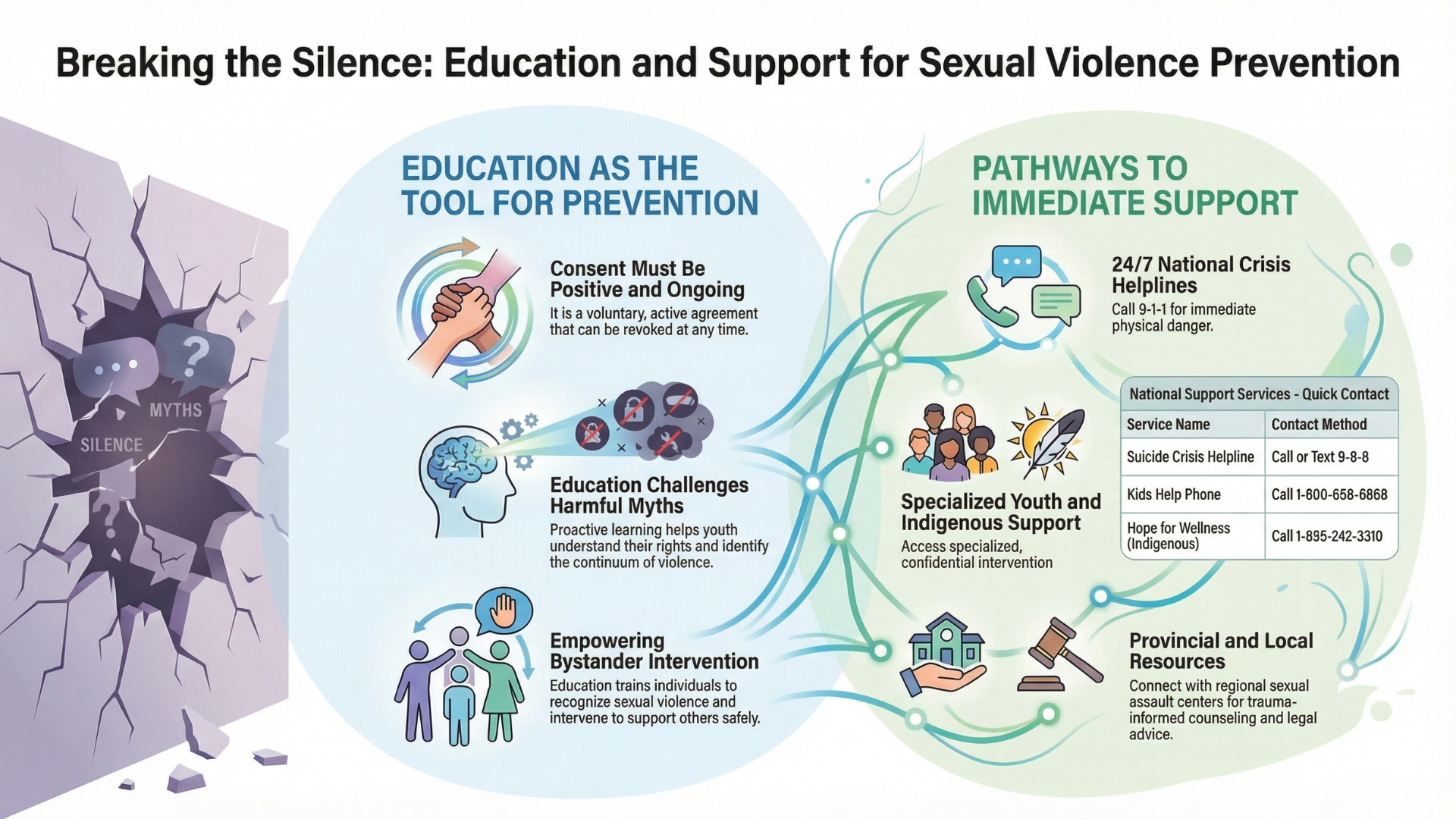
Infographic titled "Breaking the Silence: Education and Support for Sexual Violence Prevention." Two sections: Education as the Tool for Prevention covers consent as a positive and ongoing agreement, education that challenges harmful myths, and empowering bystander intervention. Pathways to Immediate Support lists 24/7 National Crisis Helplines (call 9-1-1), Specialized Youth and Indigenous Support, and Provincial and Local Resources. Quick contact table includes: Suicide Crisis Helpline (call or text 9-8-8), Kids Help Phone (1-800-658-6868), and Hope for Wellness for Indigenous peoples (1-895-242-3310).
Consent must be positive and ongoing. Education works to dismantle the myths that allow sexual violence to persist. And bystander intervention training equips communities to recognize warning signs, interrupt harmful situations, and support survivors safely and effectively.
National Support Resource
If you or someone you know needs help right now, support is available across Canada
24/7 National Crisis Helplines — call 9-1-1 for immediate physical danger.
Suicide Crisis Helpline — call or text 9-8-8.
Kids Help Phone — call 1-800-658-6868 or text HELLO to 686868. Available 24/7 for young people across Canada.
Hope for Wellness — call 1-895-242-3310. Specialized support for Indigenous peoples
Ending Violence Association of Canada — endingviolencecanada.org
Ontario Resources
Crisis and Support Lines
Assaulted Women's Helpline — 1-866-863-0511 or TTY 1-866-863-7868. Available 24/7 in over 200 languages. Confidential support for women who have experienced abuse of any kind.
Sexual Assault and Domestic Violence Crisis Line — find your nearest centre at sadvtreatmentcentres.ca
Ontario Victim Services — 1-888-579-2888. Connects survivors with local victim services, safety planning, and system navigation support.
Youth-Specific Resources
Kids Help Phone — 1-800-668-6868 or text HELLO to 686868. Free, confidential counselling for young people across Ontario and Canada, available 24/7
Planned Parenthood Toronto — ppt.on.ca. Sexual health education, consent resources, and support for youth in the Toronto area
Indigenous-Specific Resources
Kizhaay Anishinaabe Niin — kizhaay.ca. Supporting Indigenous men and boys to live free from violence. Education and healing programs across Ontario.
Nishnawbe-Aski Nation Crisis Line — 1-866-611-9090. Available 24/7 for First Nations communities in northern Ontario.
Legal Support
Legal Aid Ontario — legalaid.on.ca or 1-800-668-8258. Free legal advice and representation for eligible individuals navigating the justice system following sexual violence.
METRAC — metrac.org. Safety audits, legal information, and advocacy resources focused on ending violence against women and youth in Ontario.
Education and Training
Springtide Resources — springtideresources.org. Ontario-based organization providing training and resources on healthy relationships, consent, and gender-based violence prevention for educators and organizations.
Luke's Place — lukesplace.ca. Support and resources for women with children leaving abusive relationships in Ontario, including legal guidance.
Campus Resource
If you are a student in Ontario, every college and university is required under the Ontario Government's It's Never Okay Action Plan to have a sexual violence policy and support services on campus. Contact your student services office or campus safety team to access confidential support.
How the Sahra Bulle Foundation Can Help
The Sahra Bulle Foundation Centre for Learning and Teaching works with schools, institutions, and community organizations to build structured education programs on consent, sexual violence prevention, and institutional response. If your organization is ready to go further than awareness — to build real capacity for prevention and response — we want to work with you.
Visit sahrabullefoundation.ca or contact us at info@sahrabullefoundation.ca to learn more about our programs and upcoming training opportunities.
Silence is Not Protection. Education is how we break it.
Bill C-16: Why the Law Is Not Enough on Its Own
Bill C-16 added gender identity and expression to Canada's human rights protections. But legal recognition alone does not create safety. This post examines what the law does — and what communities still need to do.
In December 2025, the federal government introduced Bill C-16 — the Protecting Victims Act. If passed, it will formally recognize femicide in the Canadian Criminal Code for the first time. Murder committed against a woman in the context of coercive or controlling conduct, sexual violence, or gender-based hate would be classified as first-degree murder.
This is meaningful. It is also incomplete.
What the Bill Gets Right
For years, advocates across Canada have called for the legal system to name what it has long refused to name. Femicide — the killing of women because they are women — is not random violence. It follows patterns. It has context. It happens overwhelmingly at the hands of intimate partners, overwhelmingly in private spaces, and overwhelmingly in circumstances that institutions had opportunities to interrupt. Bill C-16 also creates a new criminal offence prohibiting patterns of coercive and controlling behaviour toward an intimate partner. This is significant. Coercive control is the architecture of abuse — and until now, it has largely been invisible to the law.
What the Bill Cannot Do Alone
Legislation changes what courts can do after a woman is dead. It does not train the teacher who notices warning signs. It does not equip the HR manager handling a disclosure. It does not change the institutional culture that allows controlling behaviour to go unchallenged for years before it becomes lethal. The Sahra Bulle Foundation Centre for Learning and Teaching exists in that gap — between what the law says and what institutions actually do. Legal reform without trained people, funded organizations, and accountable systems does not protect women. It documents what happened to them.
What 2026 Tells Us
The Canadian Femicide Observatory for Justice and Accountability has confirmed that 30 women and girls have been killed in Canada already in 2026. Italy, with 60 million people, recorded 10 femicides in the same period. Canada, with 40 million, recorded three times as many. Bill C-16 is an opening. The Sahra Bulle Foundation's work is what fills the space between that opening and real, community-level change.
What You Can Do
Learn: Understand what coercive control looks like and how institutions can recognize it early. Visit sahrabullefoundation.ca for resources and training.
Advocate: Contact your Member of Parliament and express support for Bill C-16 — and for the community education funding that must accompany it.
Speak: Share this post. The conversation about femicide in Canada needs more voices, not fewer.
Silence is Not Protection. The law is moving. Now institutions must move with it.
To learn more about the Sahra Bulle Foundation Centre for Learning and Teaching, visit sahrabullefoundation.ca or contact us at info@sahrabullefoundation.ca.
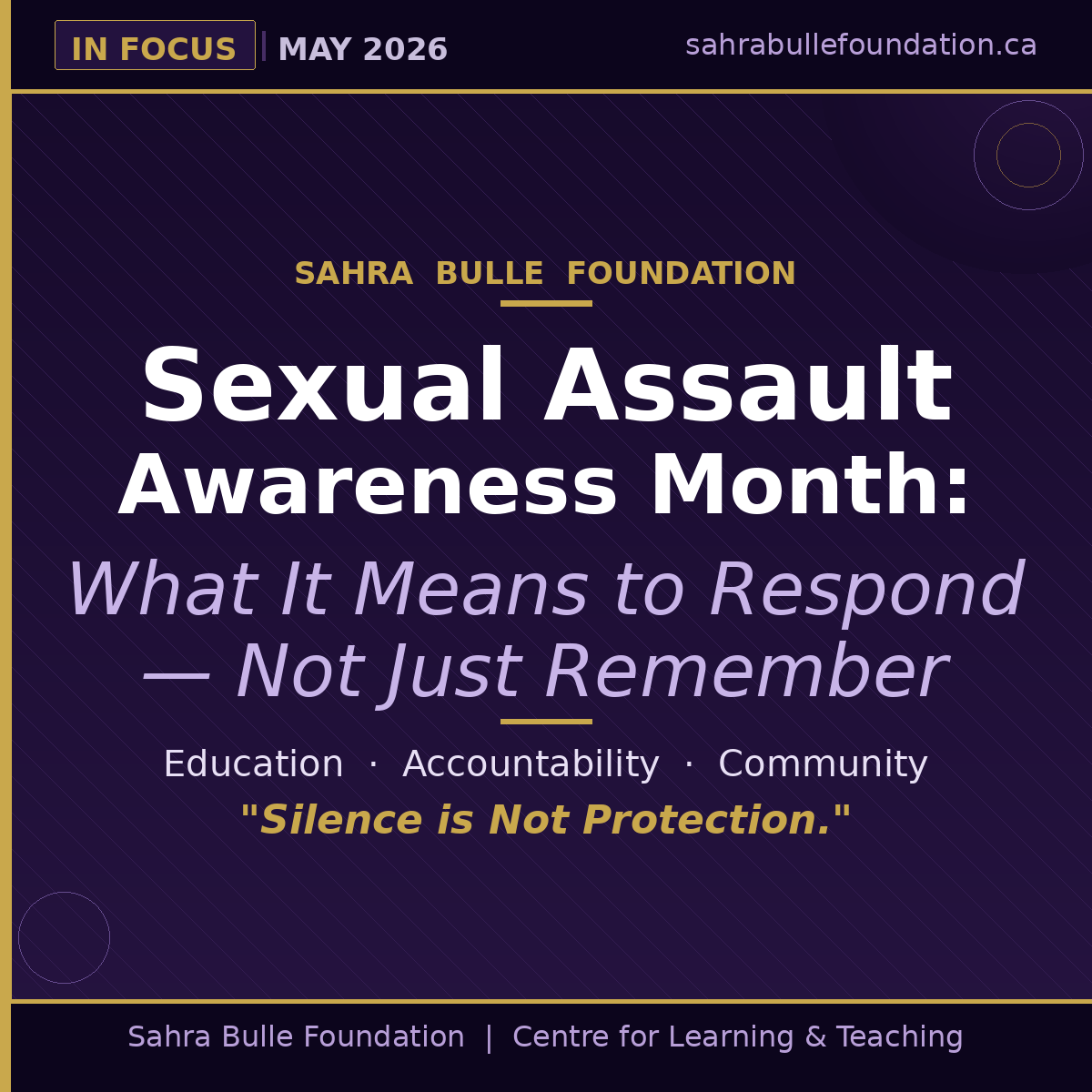
Sexual Assault Awareness Month: What It Means to Respond — Not Just Remember
Every April, Sexual Assault Awareness Month calls communities to confront the realities of gender-based violence. This post reflects on why awareness must translate into sustained institutional accountability.
Every May, Sexual Assault Awareness and Prevention Month invites communities across Ontario and Canada to pause, reflect, and act. But awareness without action is simply noise. For the Sahra Bulle Foundation Centre for Learning and Teaching, this month is a call to do what we were built to do: educate, hold institutions accountable, and build communities that know how to respond.
The Numbers We Cannot Ignore
Sexual violence is not rare. According to Statistics Canada, nearly one in three women in Canada has experienced sexual assault since the age of 15. Indigenous women, women with disabilities, and young women face significantly higher rates. And still, the majority of sexual assaults are never reported — not because survivors don’t want justice, but because institutions have repeatedly failed to provide it.
These are not statistics to shock. They are the baseline for understanding why education and accountability are not optional — they are urgent.
The Gap Between Awareness and Response
Sexual Assault Awareness and Prevention Month has grown in visibility over the past decade. Social media campaigns, candlelight vigils, and survivor advocacy have brought the conversation into public view. That visibility matters. But visibility alone does not train a teacher to recognize warning signs. It does not equip a workplace supervisor to handle a disclosure with care. It does not change the institutional culture that allows gender-based violence to continue unchallenged.
That gap — between knowing violence exists and knowing how to respond — is exactly what the Sahra Bulle Foundation was created to close.
Sahra’s story demands more than remembrance. It demands structure. It demands education. It demands that the people and institutions around survivors know what to do.
What Institutional Accountability Actually Looks Like
Accountability is a word that gets used often and practised rarely. For the Sahra Bulle Foundation, accountability means:
Training, not just policy. Organizations must move beyond having a policy on paper. Staff at every level need the knowledge and skills to recognize, respond to, and report gender-based violence appropriately.
Transparency, not just sympathy. Institutions must be willing to examine their own cultures honestly — not just respond to incidents after the fact, but proactively identify and address the conditions that allow violence to occur.
Community, not isolation. Survivors should never have to navigate systems alone. Schools, employers, community organizations, and healthcare providers all have a role to play in building the network of support that makes disclosure and recovery possible.
How You Can Engage This May
Sexual Assault Awareness and Prevention Month is a moment to move from intention to action. Here is how you can do that:
Learn. Visit sahrabullefoundation.ca to access educational resources and upcoming programming.
Speak. Share information within your workplace, school, or community. Use this month to open conversations that don’t end on May 31.
Advocate. Ask the institutions in your life — your employer, your children’s school, your faith community — what their training and response protocols look like.
Support. If you are in a position to donate, your contribution directly supports the Sahra Bulle Foundation’s education and accountability work.
Silence is Not Protection. This May, we choose to speak — and to act.
To learn more about the Sahra Bulle Foundation Centre for Learning and Teaching, visit sahrabullefoundation.ca or reach out at info@sahrabullefoundation.ca. The Sahra Bulle Foundation is based in Windsor, Ontario, and serves communities across Canada.
Tags: Sexual Assault Awareness and Prevention Month | Gender-Based Violence | Institutional Accountability | Ontario | Canada | Sahra Bulle Foundation | SAAPM | Communi